Astronomy, provenance. Two 1553 works, one binding- Elementa Doctrinae... (Caspar Peucer), Theoricae Novae... (G. Von Peuerbach). Wittenberg
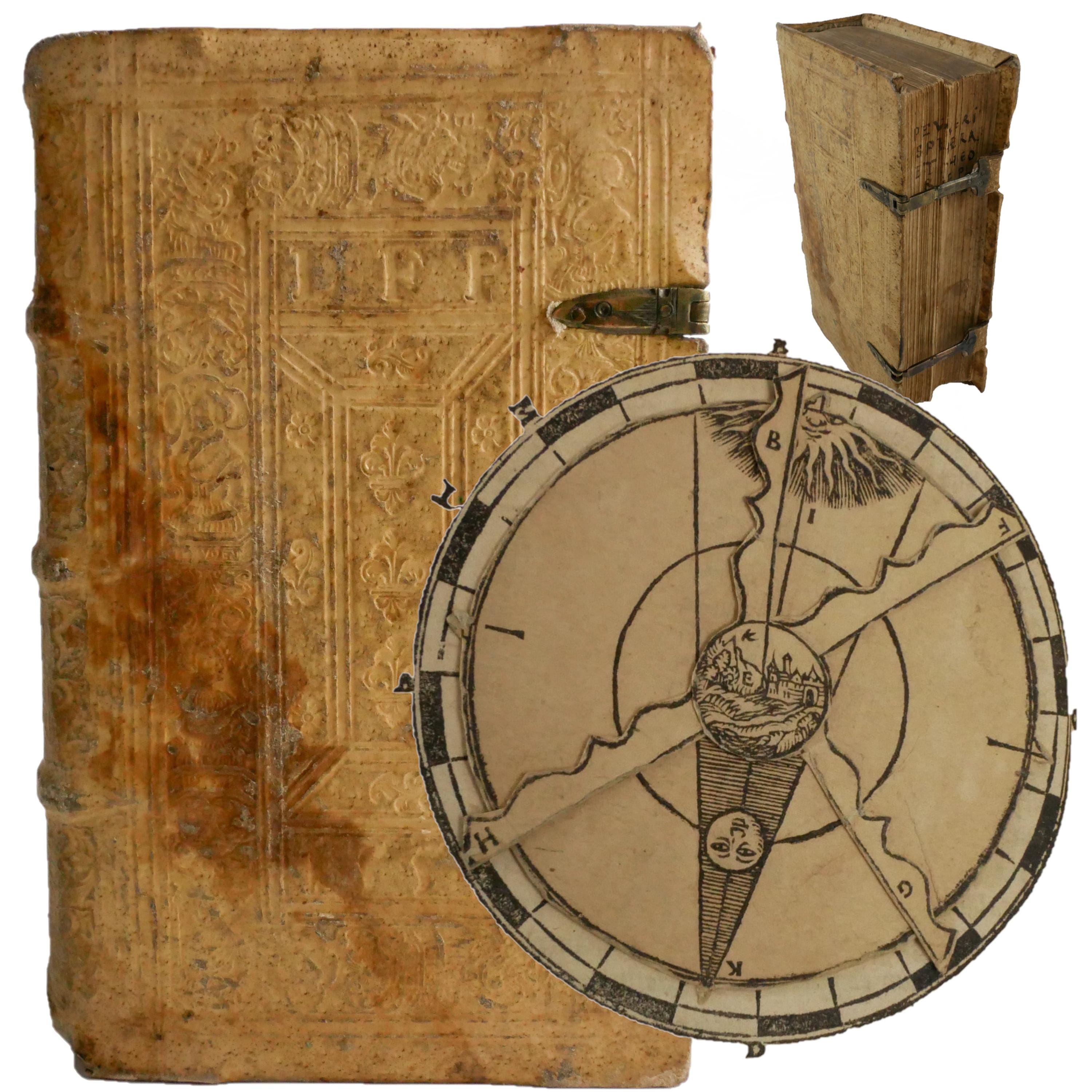
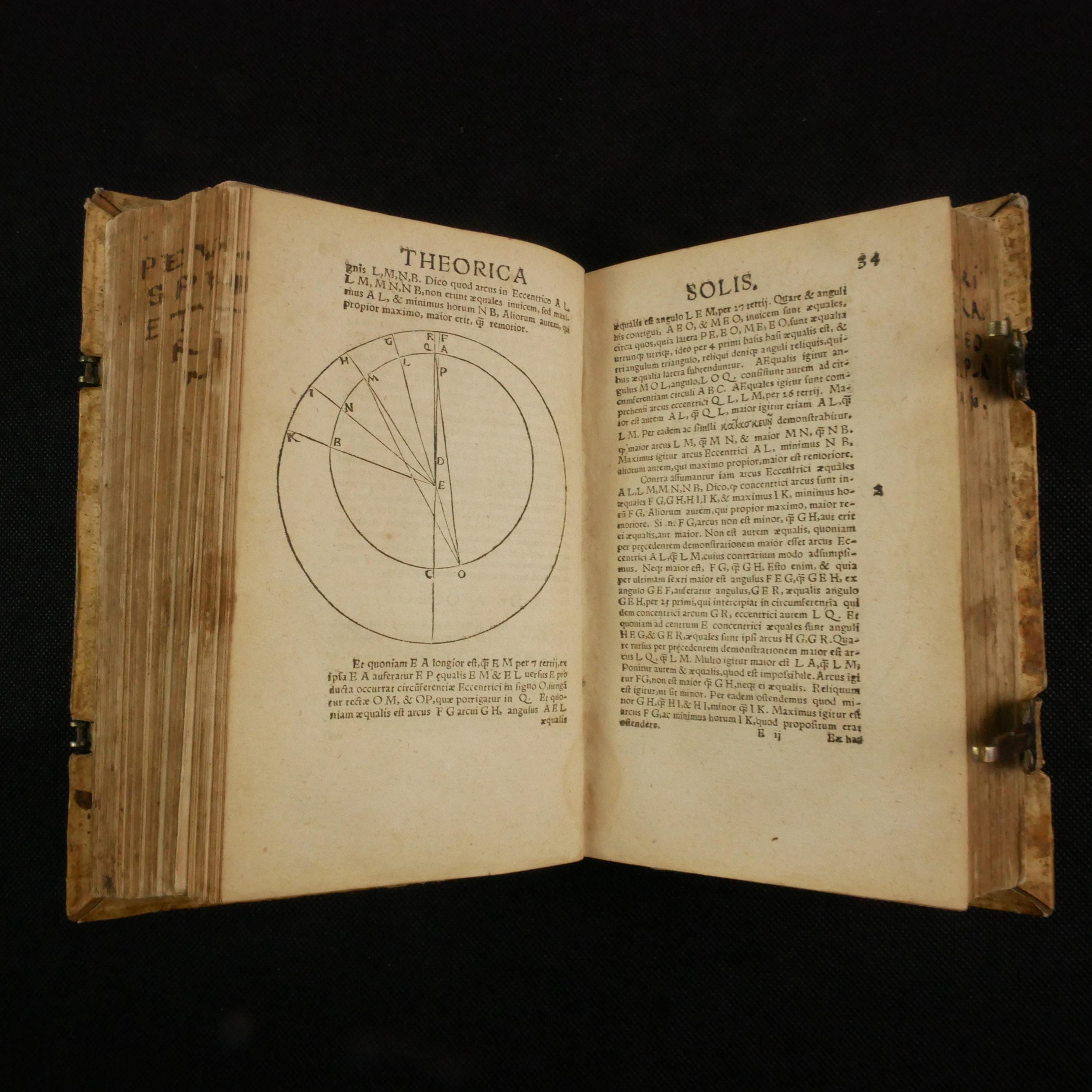
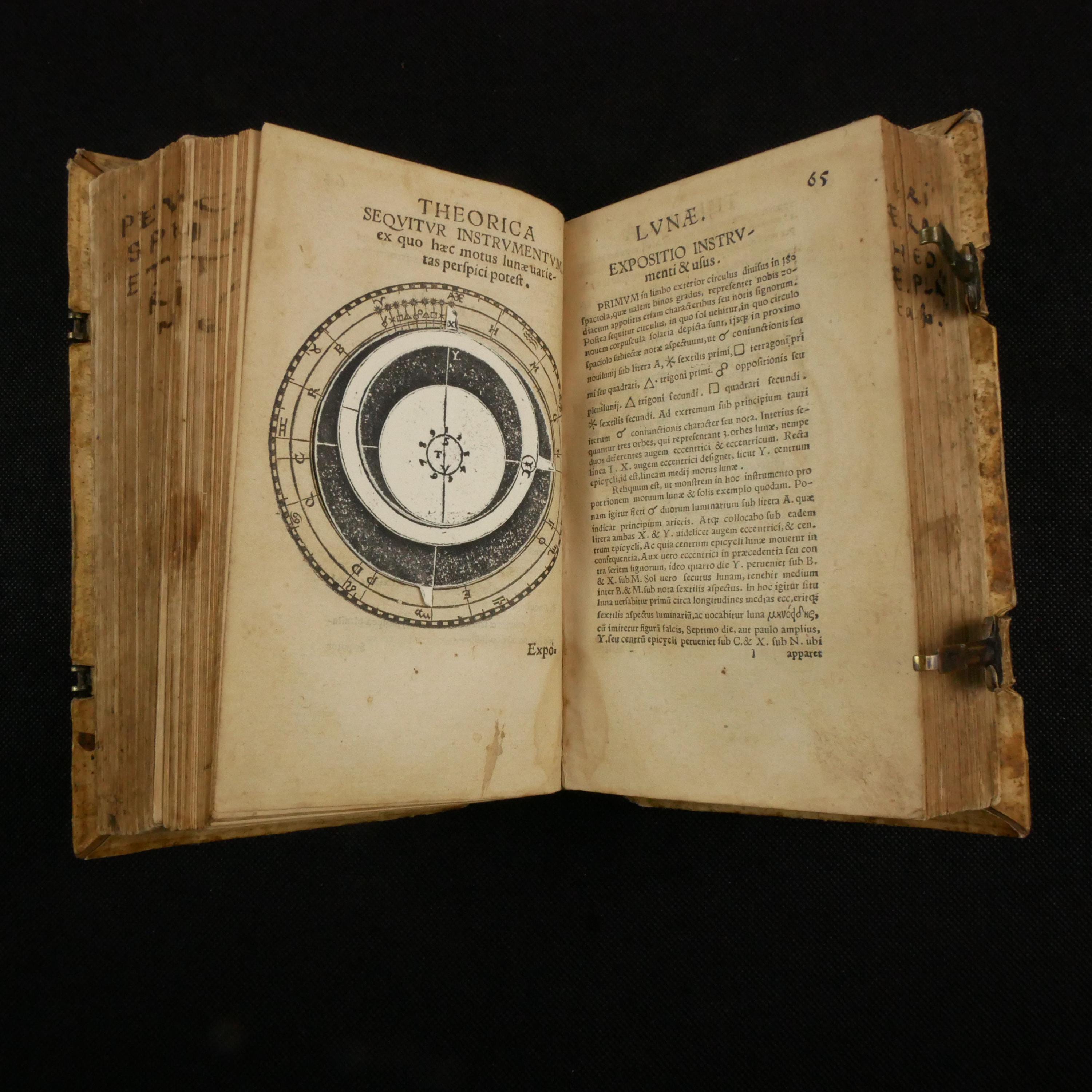
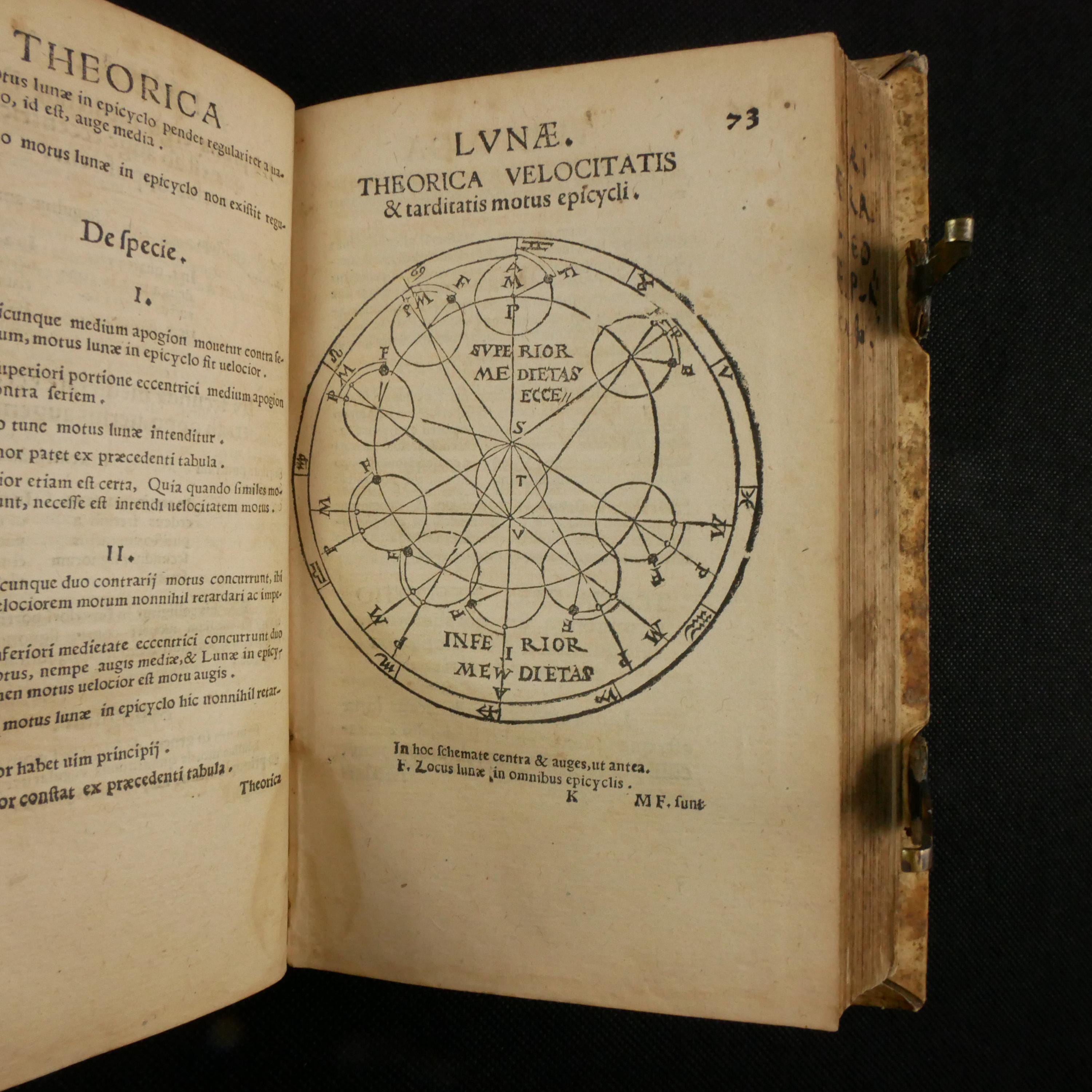
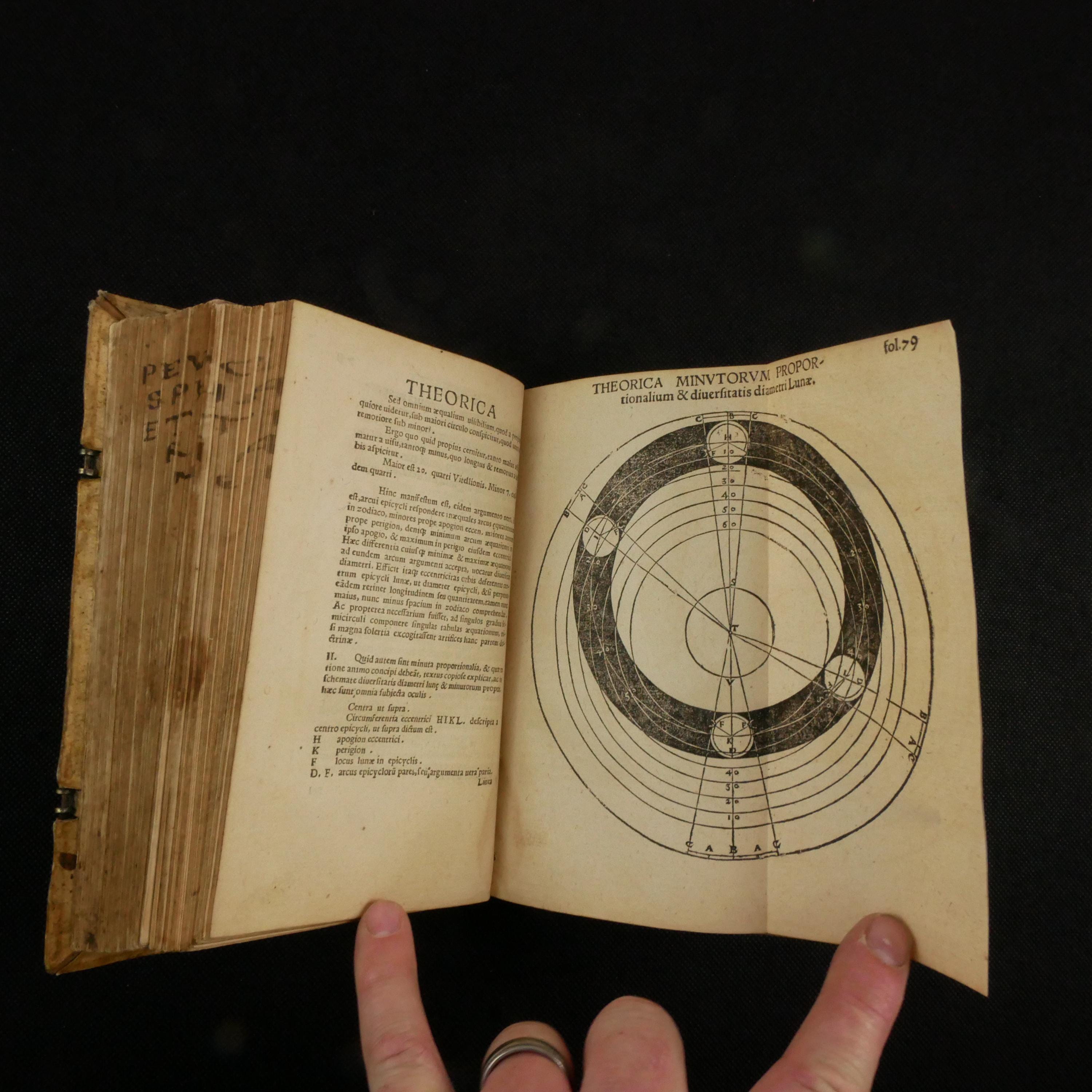
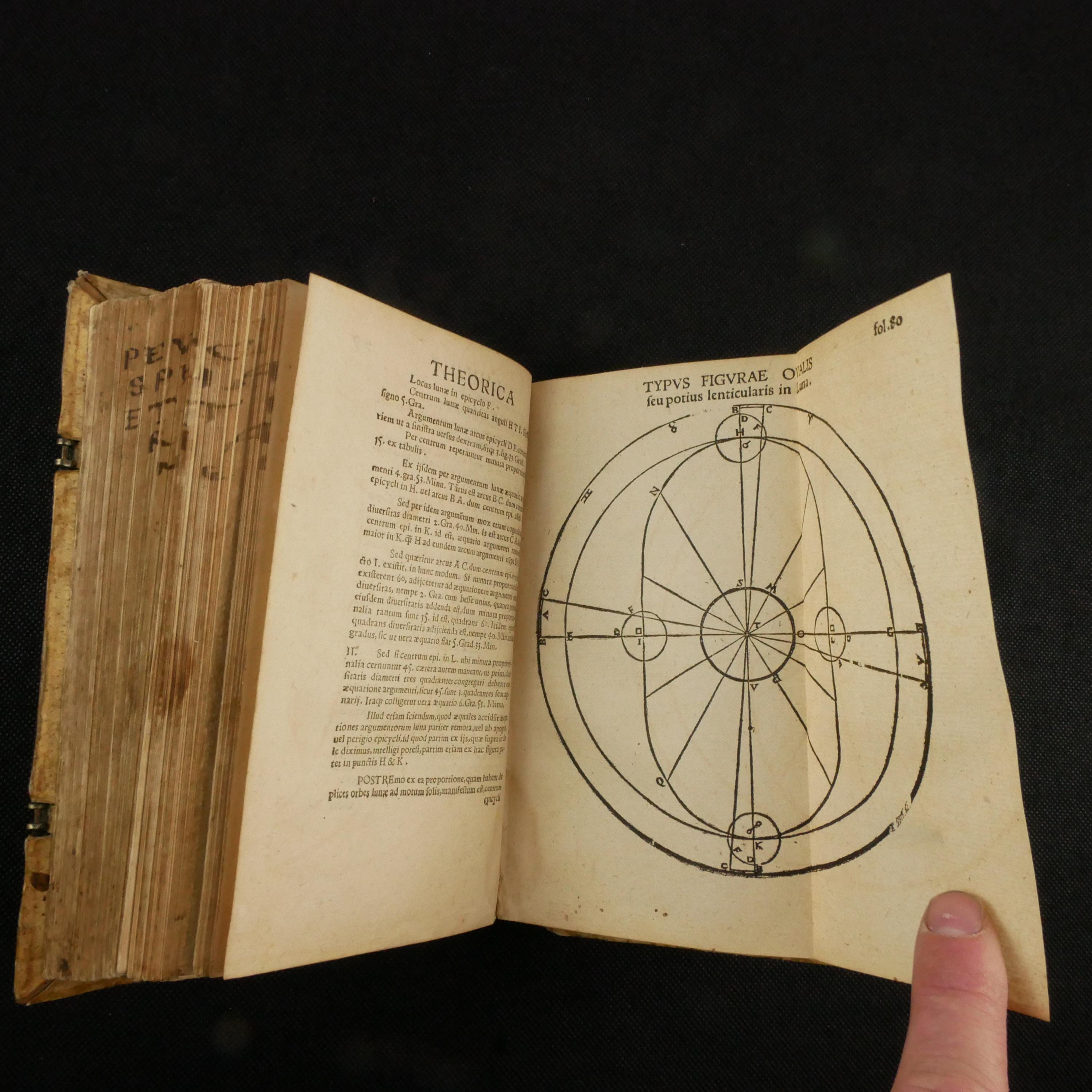
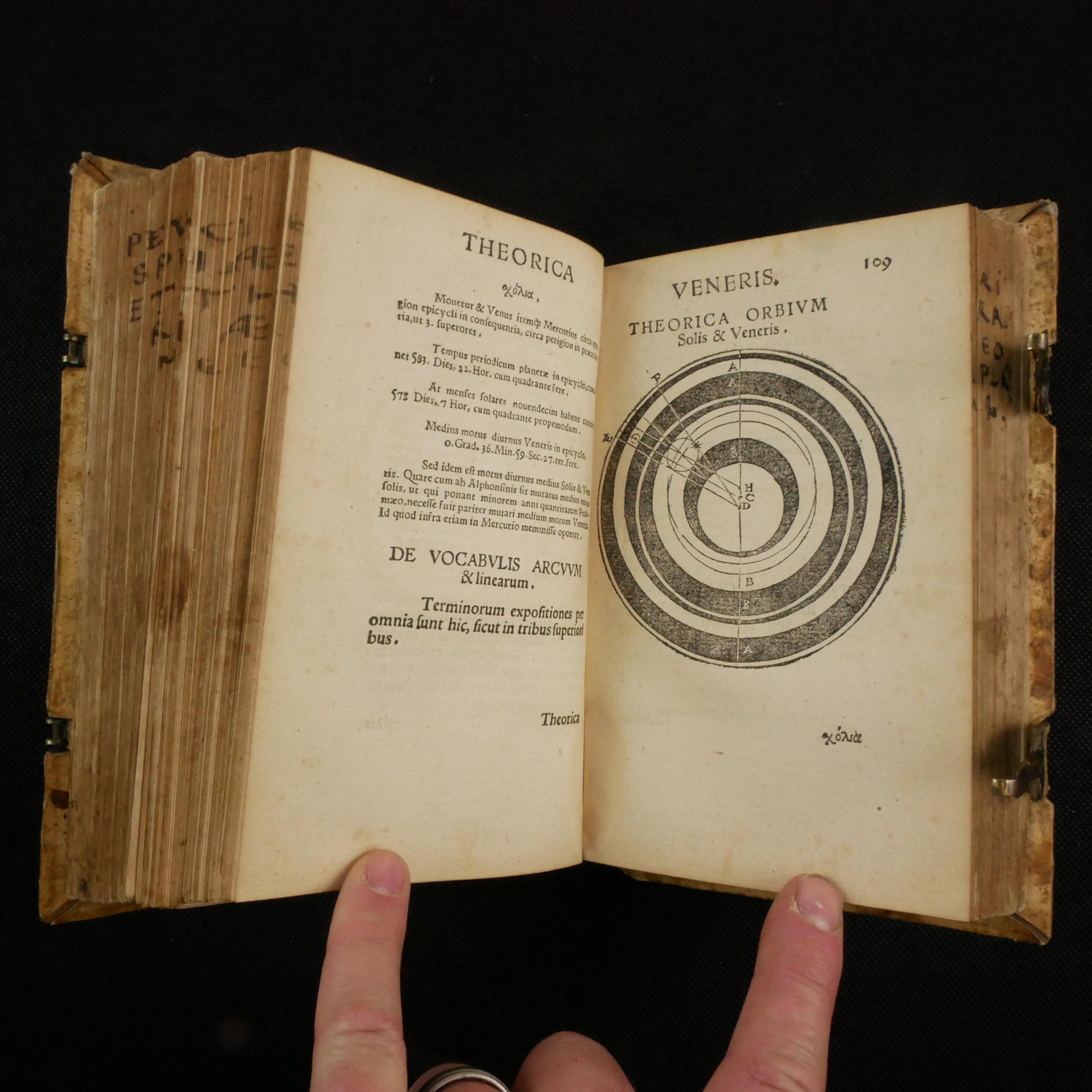
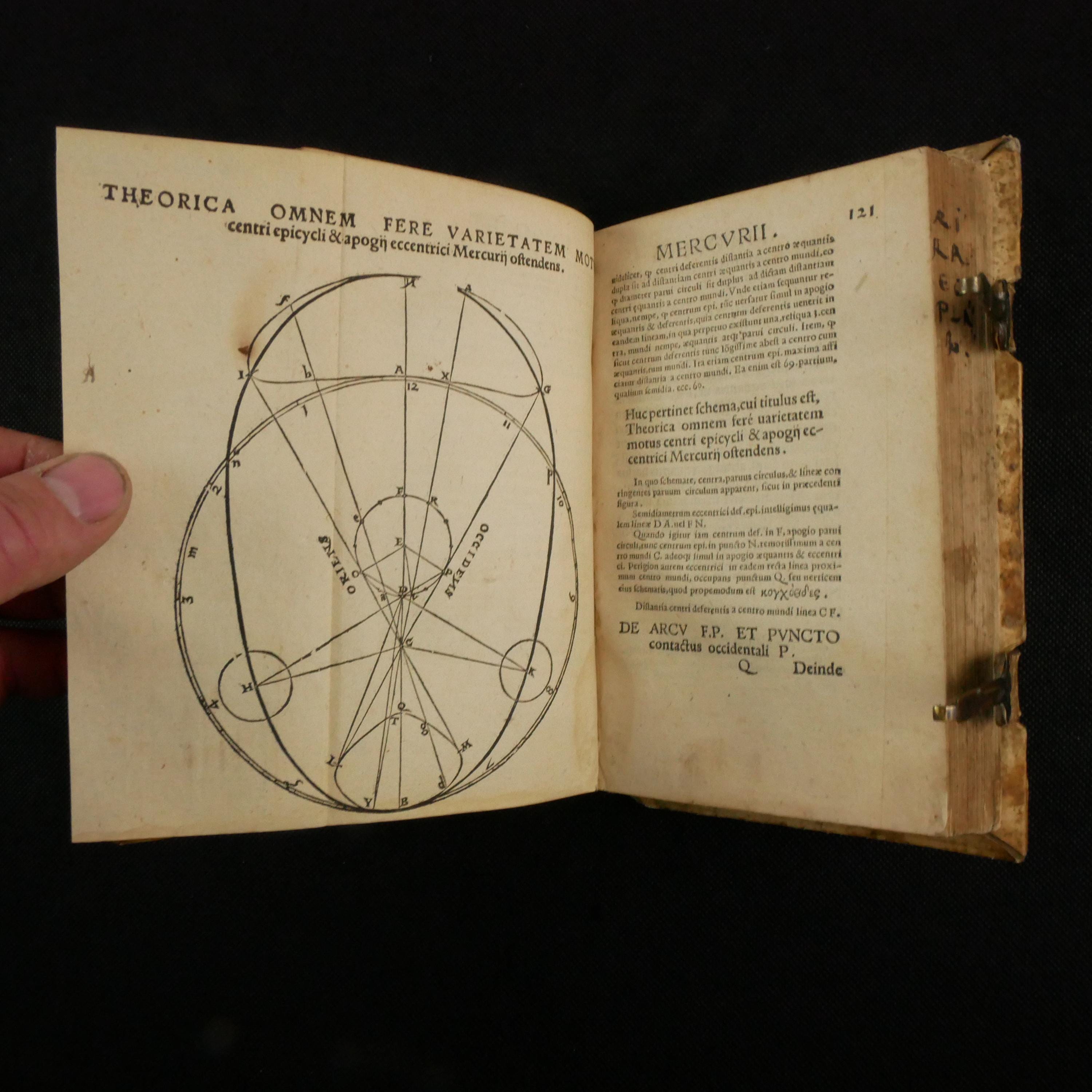
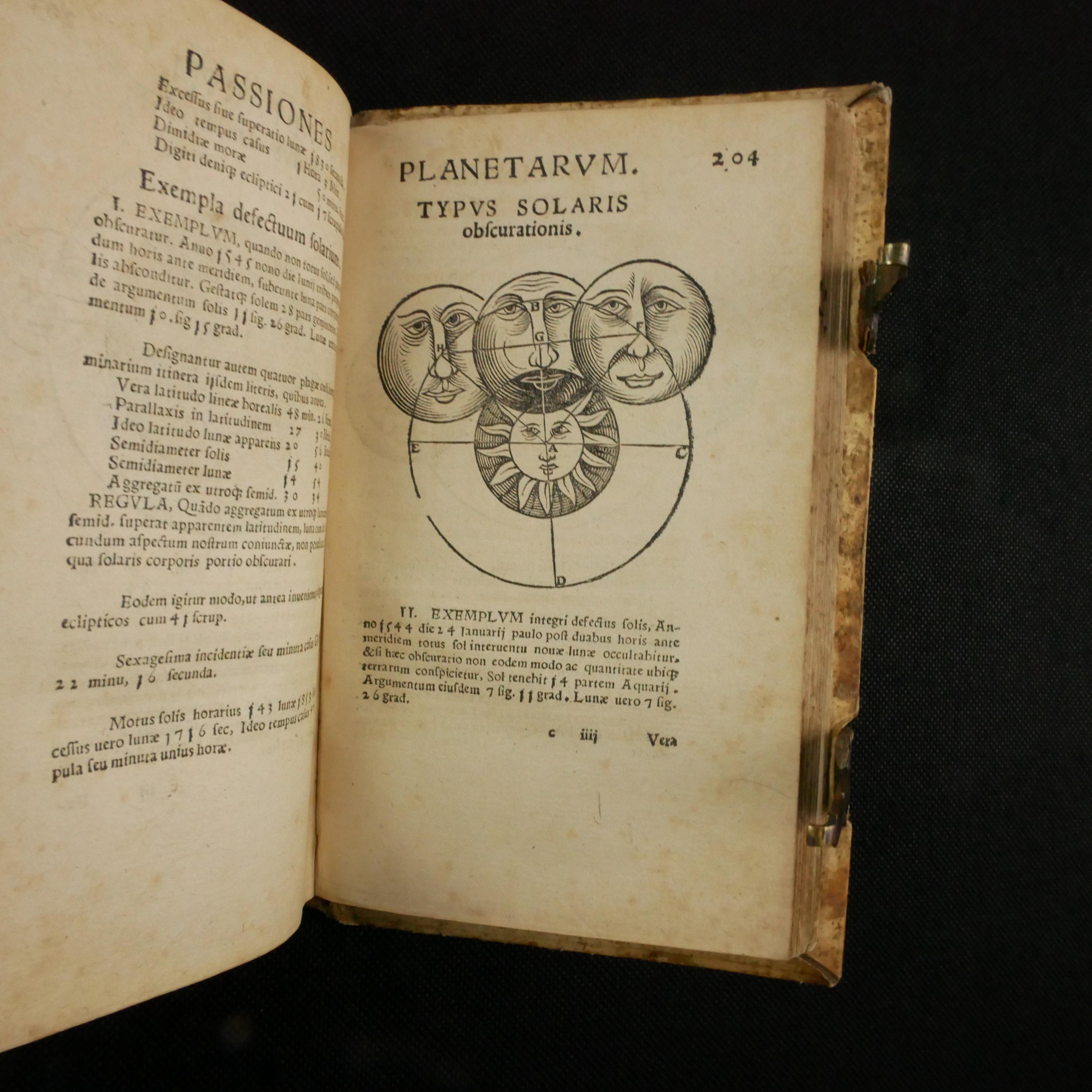
Two important 1553 astronomy works (in one binding), well-illustrated, with working (restored/facsimile) volvelles, fold-outs, in a fantastic contemporary (likely) Wittenberg stamped pigskin binding, with working closure clasps and fore-edge titling, that was once in the collection of the notable astronomer/historian/author Owen Gingerich. A remarkable summation of historic astronomy works, volvelles, illustrations, binding and provenance (both historic and modern); as an object, this copy is impressive and I'll be sorry to see it leave my shop when it sells.
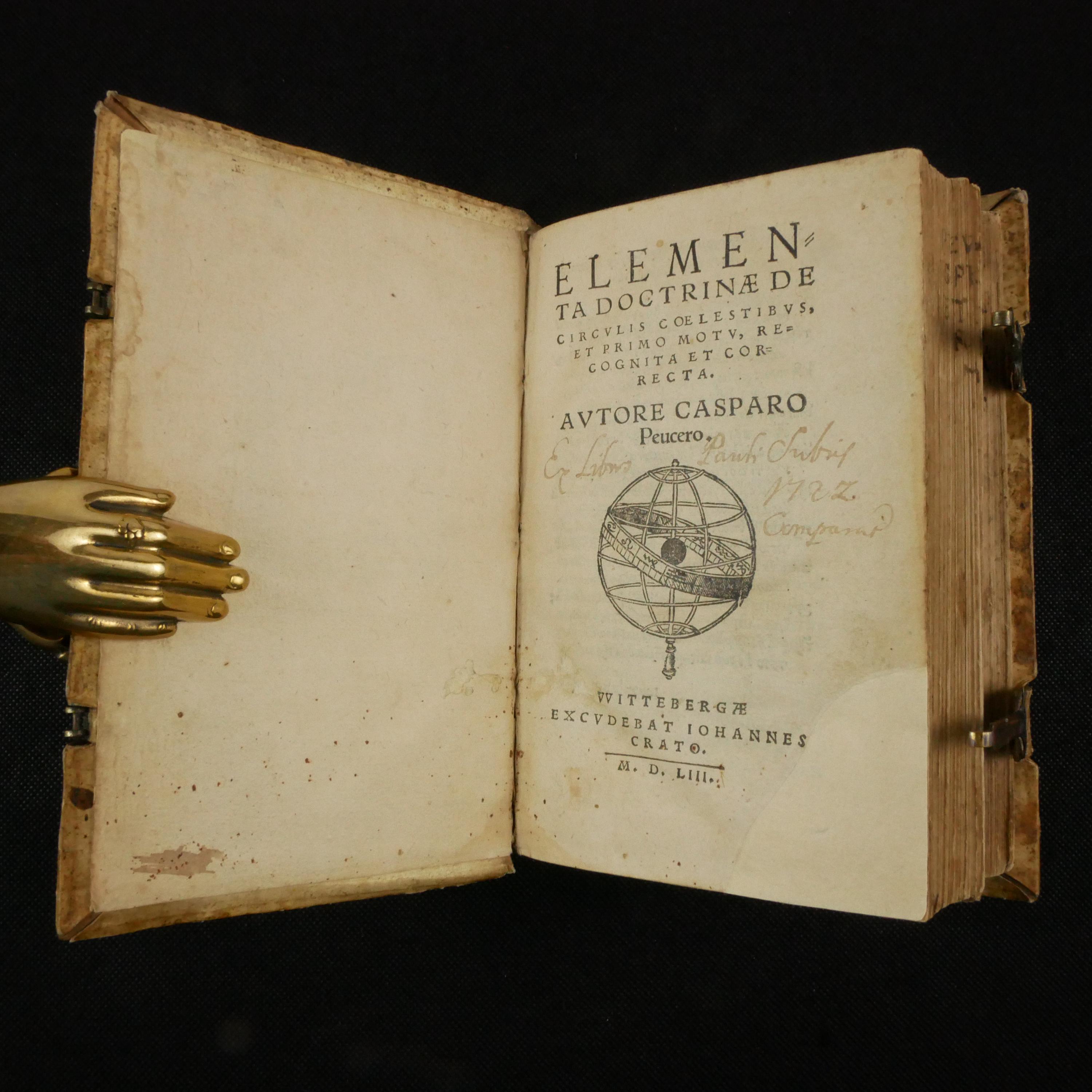
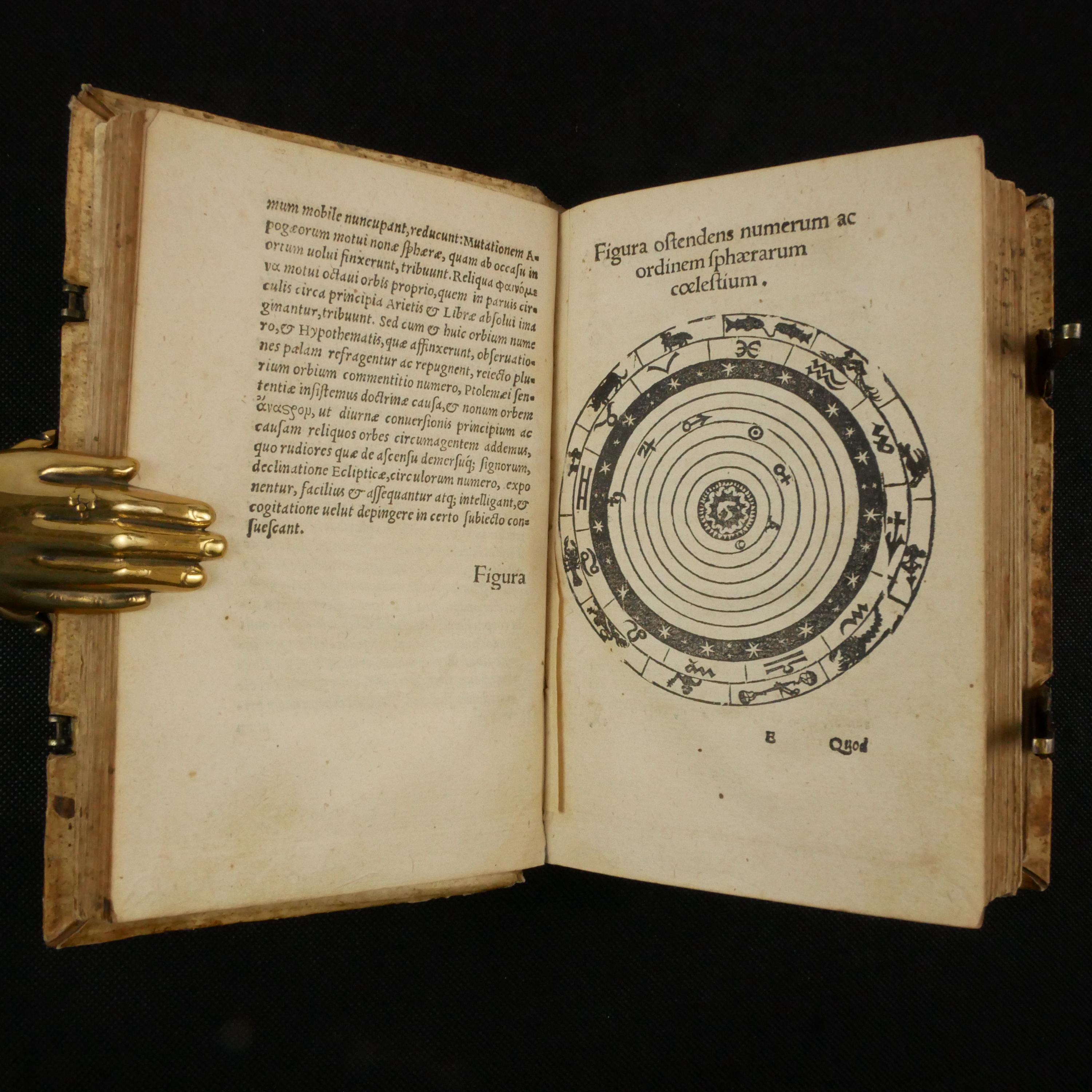
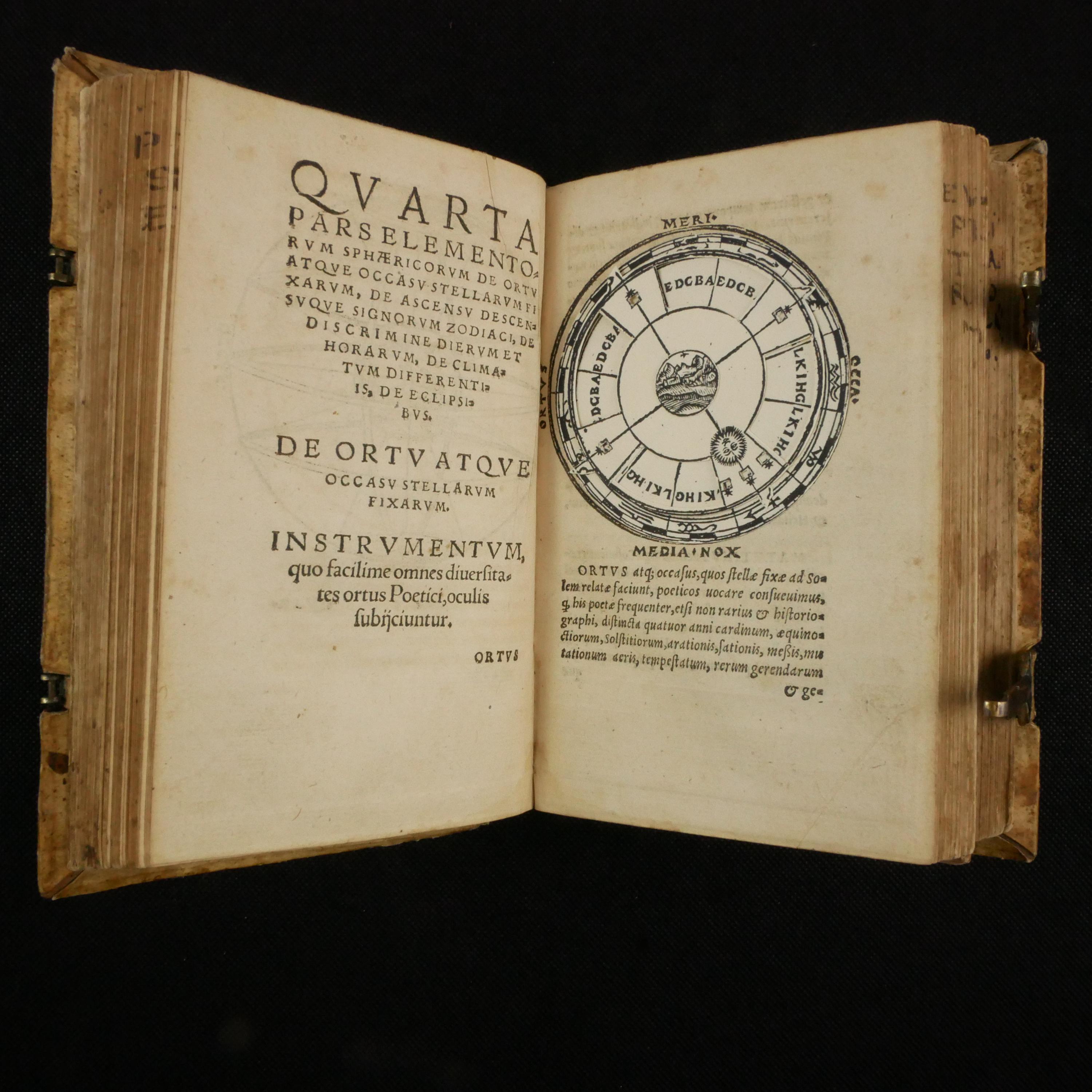
The first work, Caspar Peucer's Elementa Doctrinae de Circulis Coelestibus, et Primo Motu..., is Peucer's updating of the introductory astronomy training manual for University students, building on works such as Sacrobosco's De Spaera, but expanded to include updated star tables, theories, measurements, etc. Notably, Peucer used the Copernicus-based star tables to better calculate heavenly locations, while still retaining the earth-centric (geocentric) theory.
Peucer didn't disregard the earlier works, but built on them. In fact, in the introduction he states that the purpose of the work is to bridge the gap between Sacrobosco and Theoricae Novae. Some of the illustrations and volvelles in this work are often found in 16th-century printings of Sacrobosco's work, further aligning them.
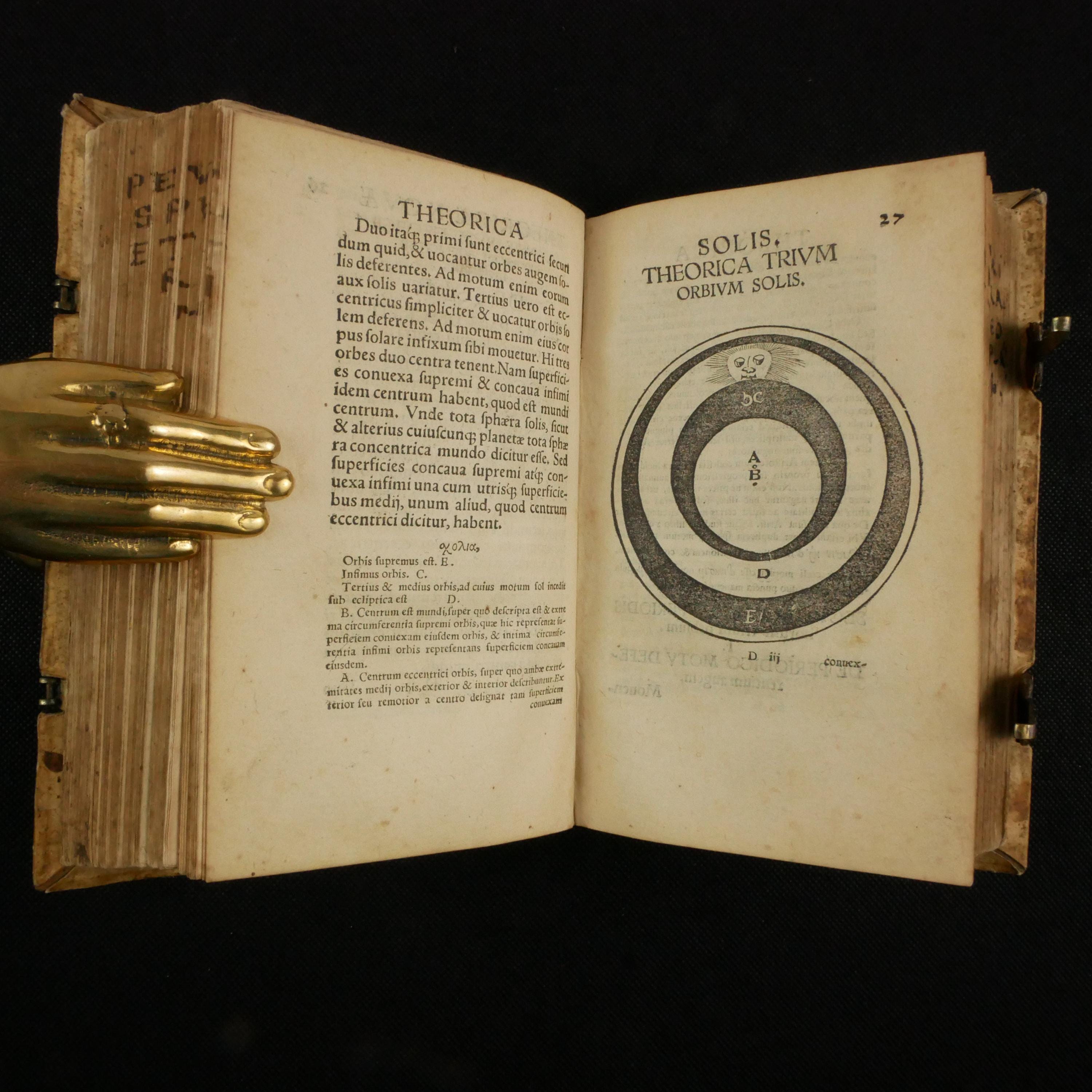
Very appropriately, in this copy, bound behind Peucer's work, is a 1553 edition of Theoricae Novae, a 15th century work on the movement of the planets with Erasmus Reinholds edits to incorporate Copernicus-based planetary movement calculations. Reinhold was the professor of maths/astronomy, in 1553 Wittenberg, but died that year; Peucer took up his post.
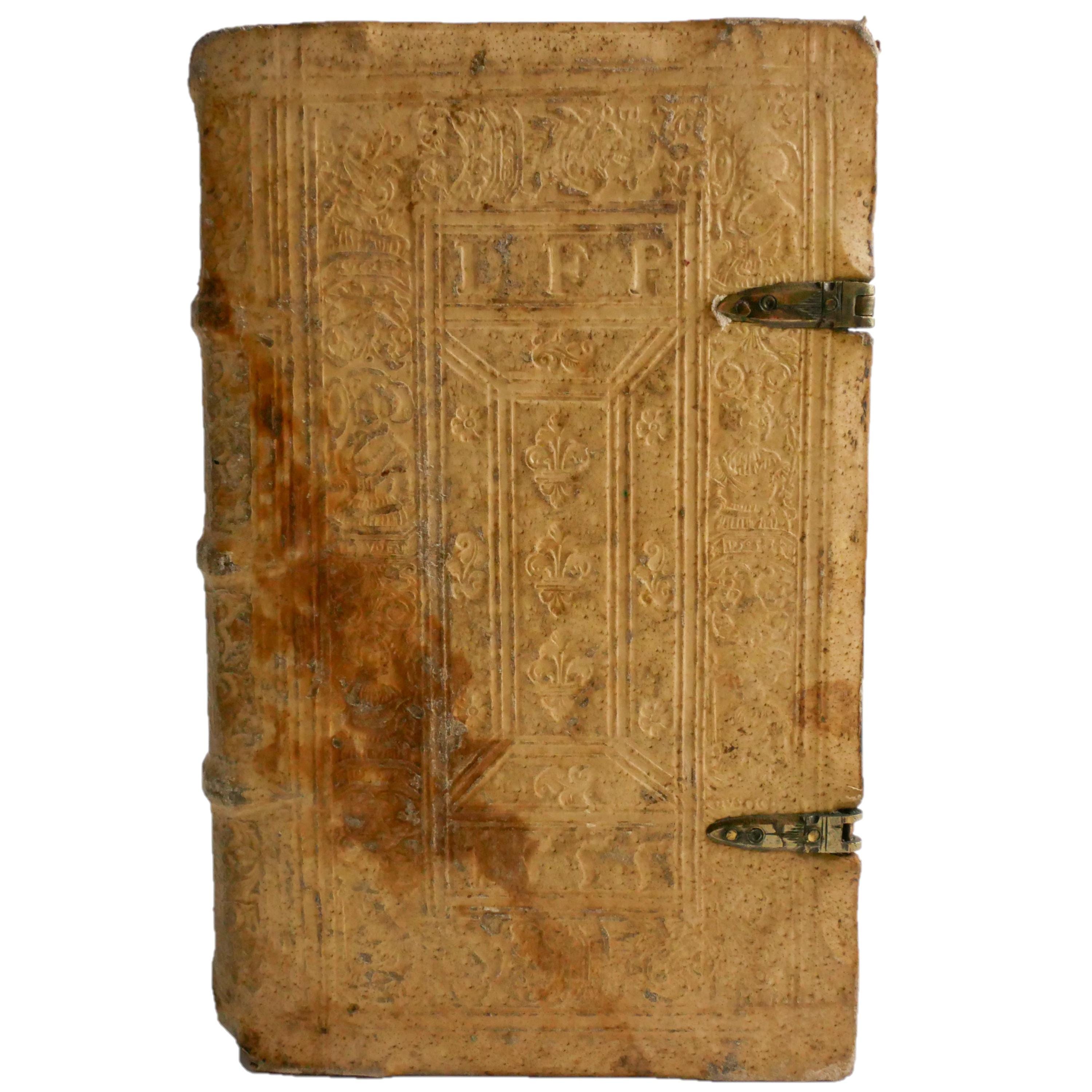
The binding of this book, with Justitia (and the other ladies in the band) and the initials B.P. (on the front board, just above the LFP initials), was executed by a known binder (see details below), who in 1553 also bound a Martin Luther work printed in Wittenberg, making it highly likely B.P. was binding in Wittenberg. That, likely, places this copy in Wittenberg, in 1555, when Caspar Peucer was teaching from these two works. It is probable that this is an affluent student's copy, from someone engaged in Peucer's courses circa 1555 ("affluent" because this is a very nice binding, beyond the common student's vellum wrap).
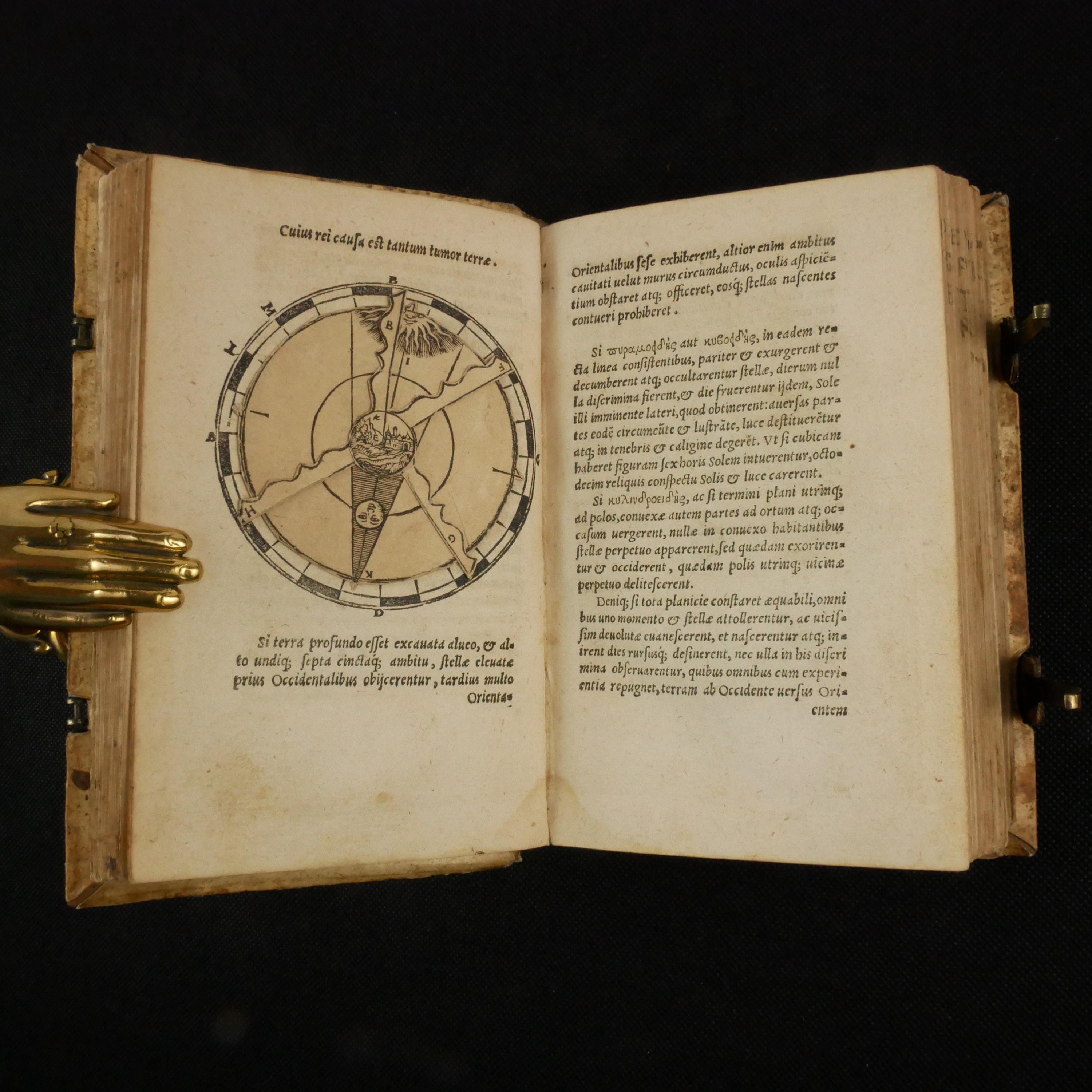
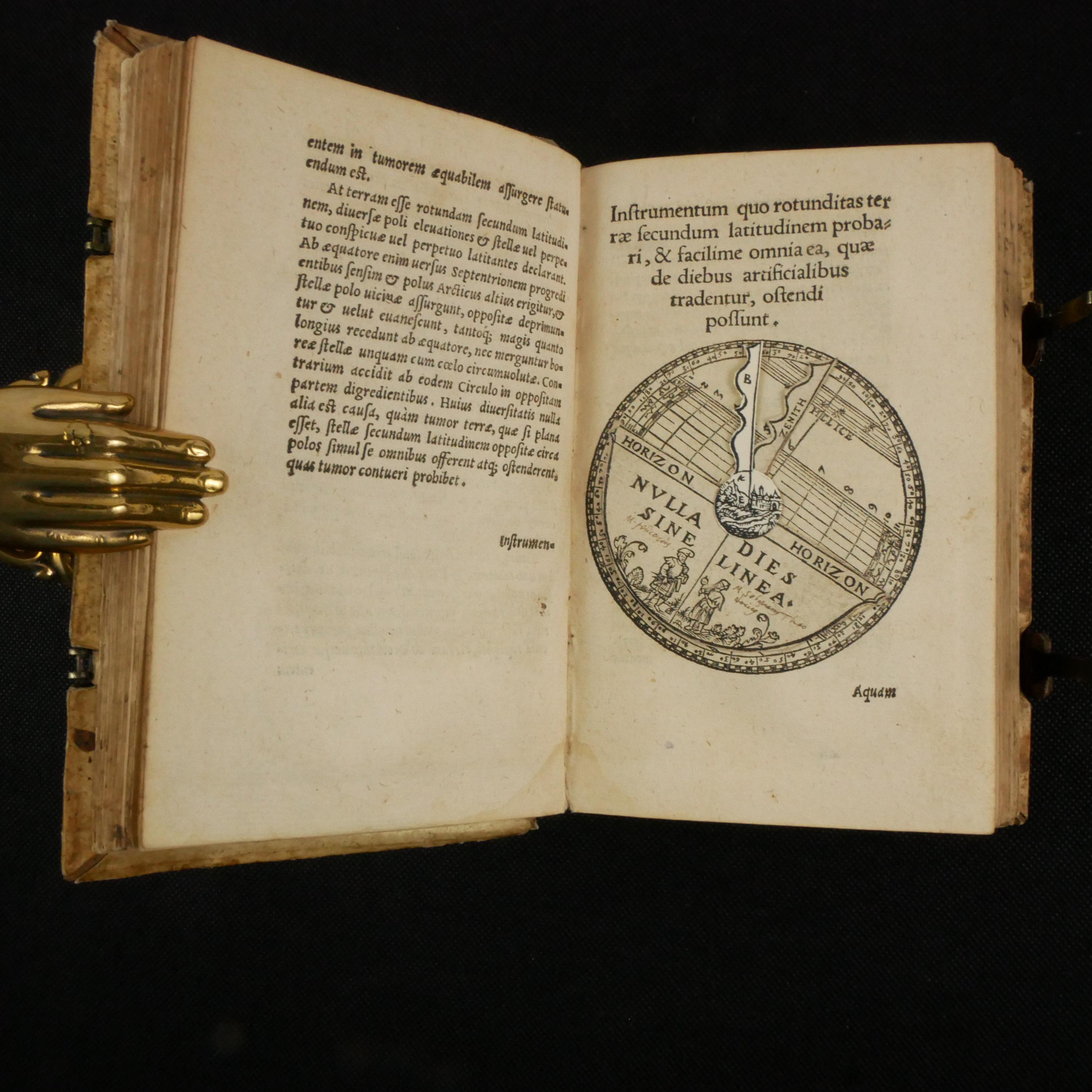
The book had tasteful restoration work (title page corner also), which includes repairing the six volvelles; a few parts of the volvelles look as though they might be original, but it's impossible to tell, and many other parts are obvious replicas/facsimiles. Volvelles are movable diagrams, that can be considered analog computers; the user inputs several points of data, by moving the spinning parts, and they are given an answer. The Peucer work has four volvelles, and the Peuerbach work contains two.
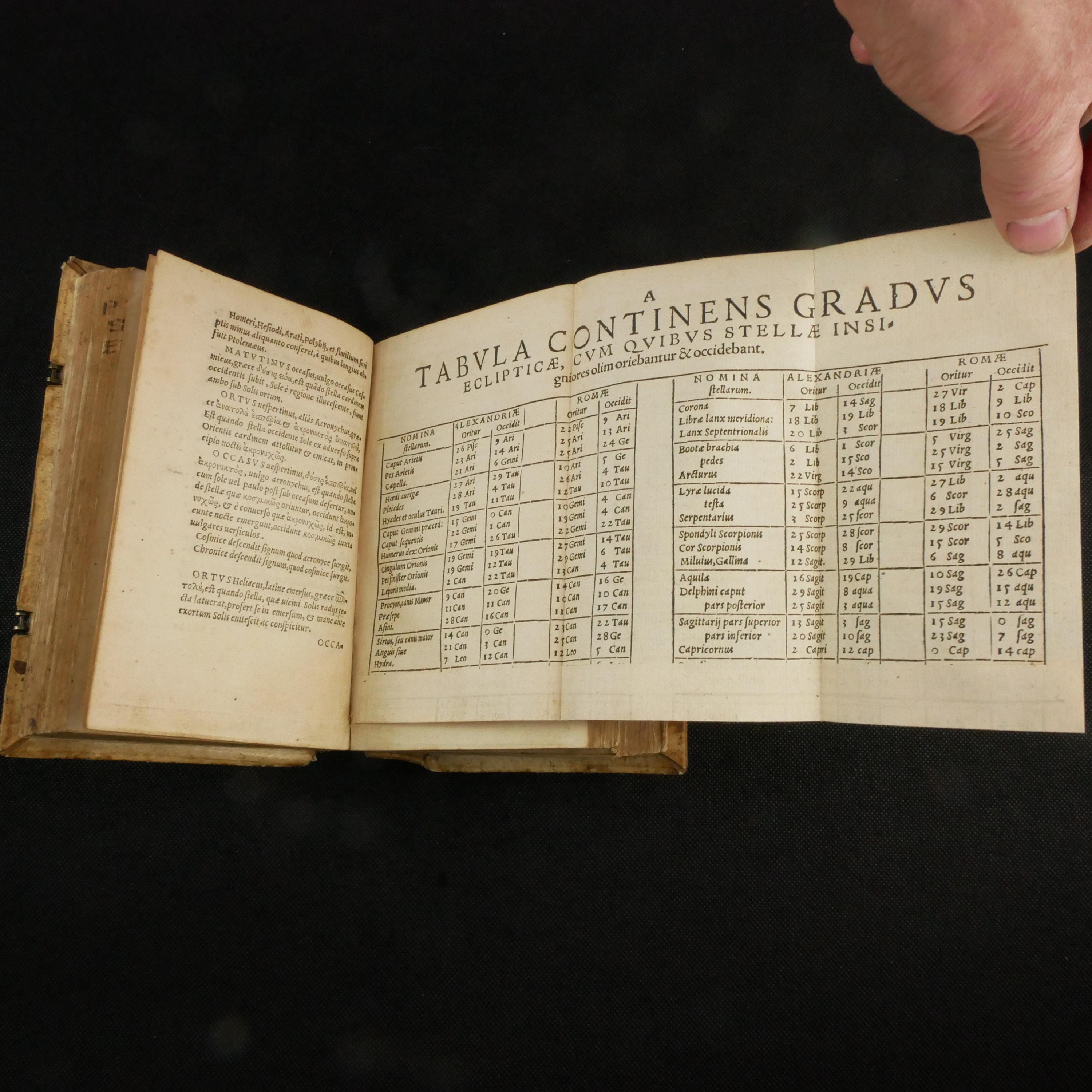
There are also eleven fold-outs through the two books, mostly containing tables of information.
Provenance -
The ticket of the noted Harvard professor, astronomer, historian and author Owen Gingerich is found on the front pastedown.
Bibliographic Details -
Peucer - Universal Short Title Catalogue (USTC) number 649658, 15 copies recorded in the world's libraries.
Peuerbach - Universal Short Title Catalogue (USTC) number 696934, 17 copies recorded in the world's libraries.
Regarding the binding, the Justitia (etc) panel stamps, with the B.P. initial are recorded in the German bookbinding database (EINBANDDATENBANK) as r001230, attributed to workshop W002710. Konrad Haebler, who studied these rolls, wrote that B.P. also executed a binding on Chronica D. Mart. Luthers, also printed in Wittenberg in 1553 (page 323-324 of his 1928 Rollen-und Plattenstempel). I haven't been able to verify the following, but A.I. claims the binding scholars Ilse Schunke and Konrad von Rabenau also attributed workshop W002710 to Wittenberg.
Physical Attributes -
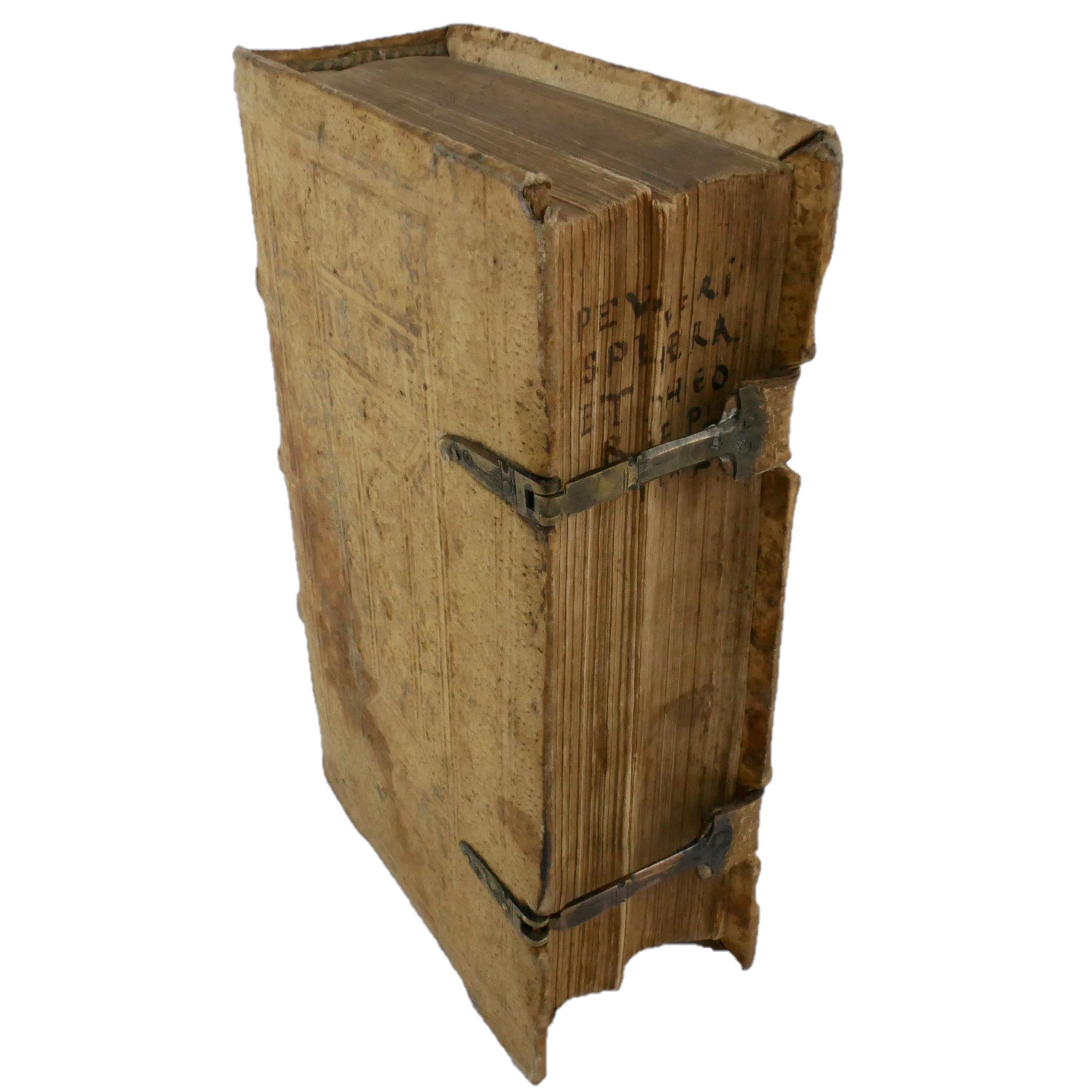
Measures approx. 17 x 10.5 x 4.5 cm. Blind-stamped pigskin binding over wooden beveled boards. Board with a central panel with fleurs, surrounded by a frame consisting of panels of Justitia, Lucretia, Prudentia and Suavitas. Working closure clasps still present and functioning. Binding dated 1555. Title on fore-edge of text block, in an old hand.
Two printed works bound into one binding.
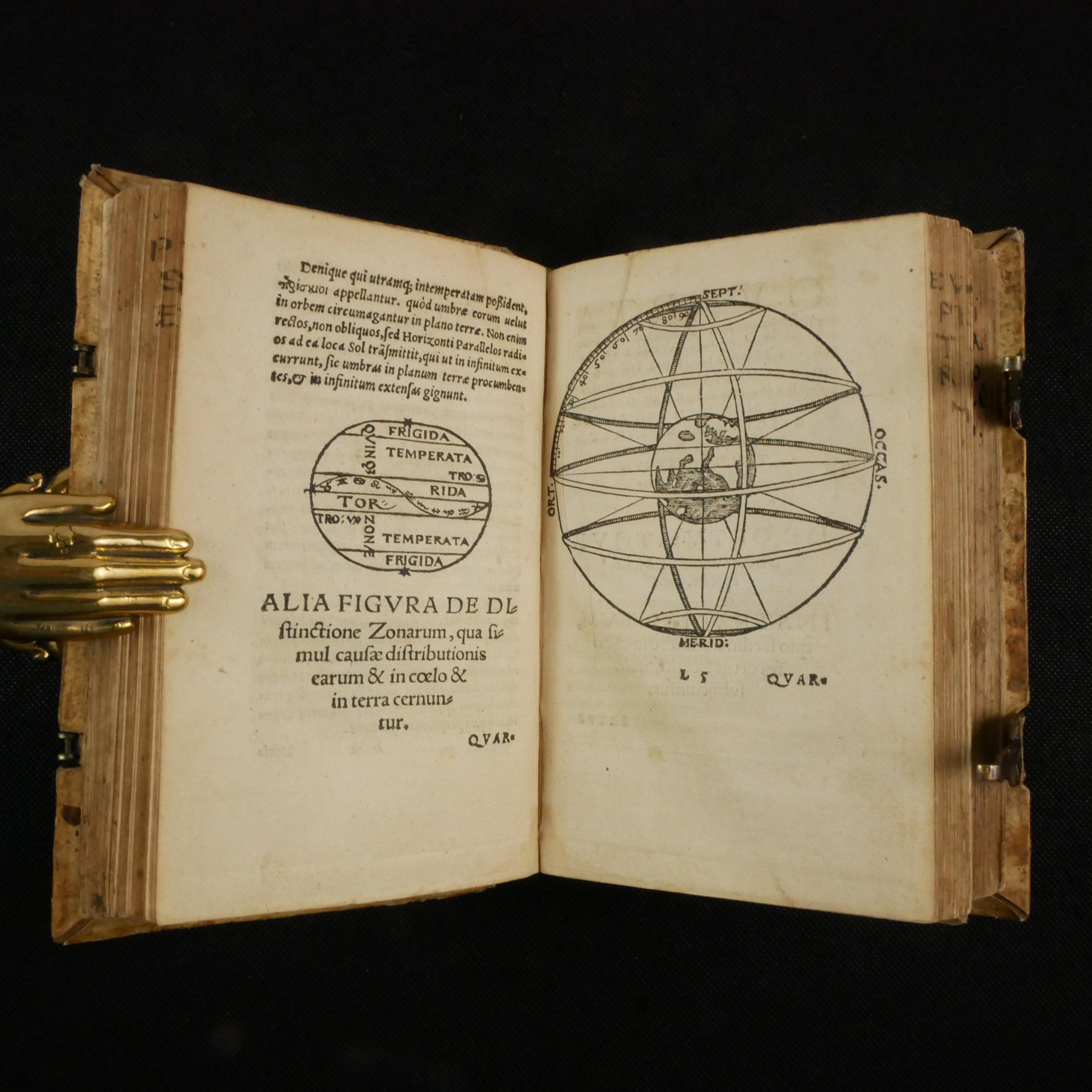
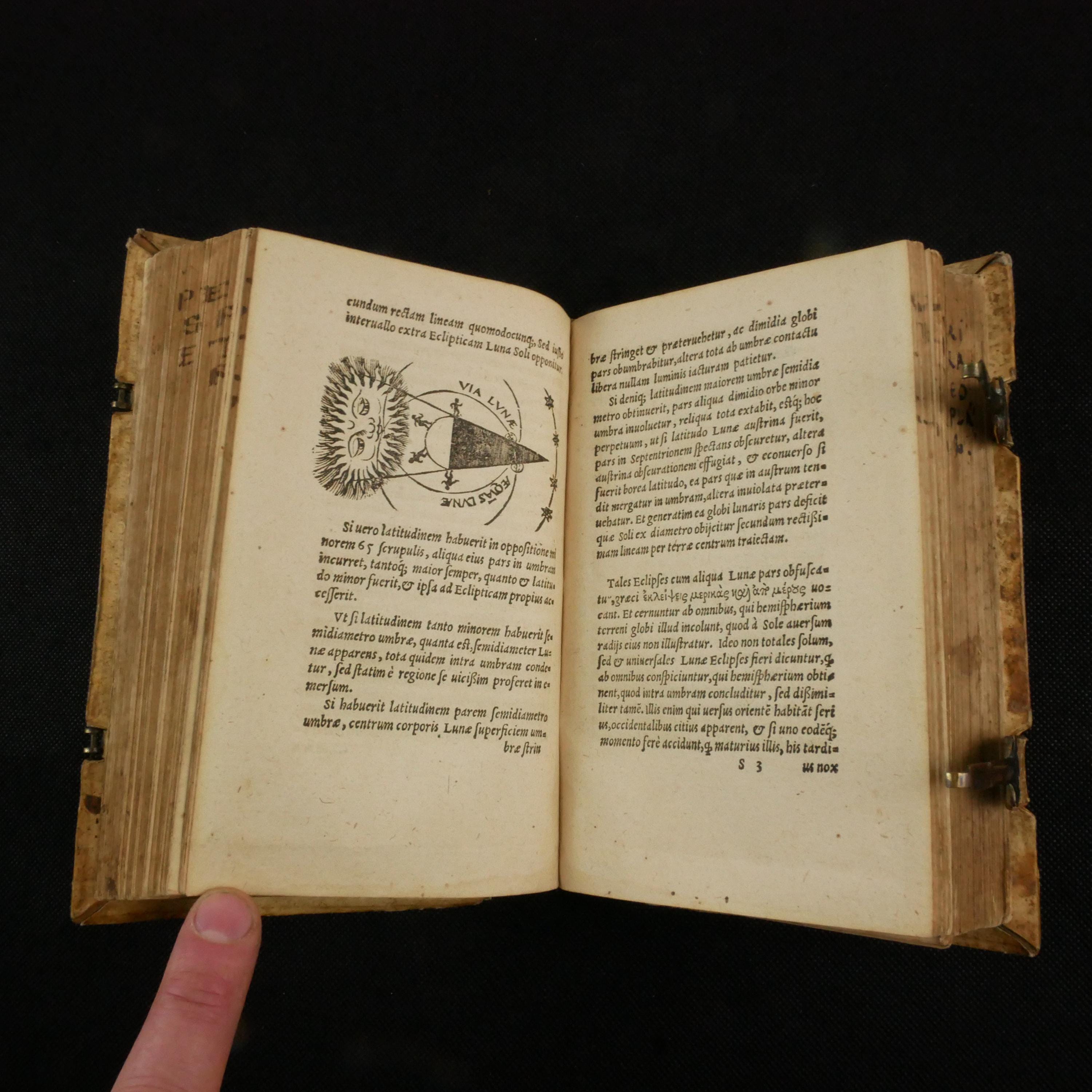
Both works are well-illustrated with in-text illustrations, diagrams, etc.
Peucer's work includes four volvelles, and eight fold-outs.
Peuerbach's work includes two volvelles, and three fold-outs.
Collation
Peucer, not paginated, gatherings of eight - *8, A-S8, T4
Peuerbach, gatherings of eight - [8 leaves, introductory], ff. 1-252, circle/dot8, A-Z8, a-h8, i4
Condition -
See pictures. Wear to edges and corners of binding, occasional stain, rub, etc. to boards, some fading of blind stamping (spine more). Chip at tail of spine. Some ink spots along text block edges, fore-edge with titles in old hand. Ex-libris ticket and "420" in graphite on front pastedown. Heavy thumbing, toning, several ink marks to FEP.
Text block with occasional fox spots, ink spots, errant ink marks, thumbing, toning, dog-eared corners, page-edge tears, candle ember mark, etc. Occasional moisture mark near edges/bottom gutter.
Title page with 18th century inscription and repaired bottom corner. Old hand writing F7r volvelle. Marginal annotations P8-Q2. Theoricae - F7 underlined. Moisture mark from bottom gutter. Repair to back of M7r due to volvelle. N3 torn across but old repair back together. Moisture mark from bottom corner at rear. Numbers on rear pastedown (shelfmark?).
Shipping from United States
Processing time
1-3 business days
Customs and import taxes
Buyers are responsible for any customs and import taxes that may apply. I'm not responsible for delays due to customs.
Payment Options
Returns & Exchanges
I gladly accept returns
Just contact me within: 7 days of delivery
Ship items back to me within: 14 days of delivery
I don't accept exchanges or cancellations
But please contact me if you have any problems with your order.
Conditions of return
Buyers are responsible for return shipping costs. If the item is not returned in its original condition, the buyer is responsible for any loss in value.
Privacy policy
We do not collect any private information. For billing, Etsy provides the service. We only receive notice that payment was made. The shipping address is provided to us by Etsy, based on what they buyer submitted during check-out. We do not store these addresses. That is the extent of the information that we receive during a transaction.